Private Light, Damp Air: Bathroom Stained Glass That Earns Its Keep
Bathroom windows ask a lot of a piece of glass. They need to let in enough light to shave by, hide you from the neighbour’s upstairs landing, and survive a room that spends half its life somewhere between warm bath and tropical greenhouse. Stained glass can do all three, but only if the design starts with the room rather than a pattern book.
Start with the room, not the pattern
Before you fall for a colour or a motif, look at the window in situ. Which way does it face? How overlooked is it? Is it a draughty Victorian sash in a terrace, a 1930s semi with a small frosted pane, or a big sheet of glass in a modern extension? A north-facing bathroom usually wants the lightest possible treatment: pale opalescent glass, a quiet texture, maybe a thin border of colour. A sunny south-facing window can carry more colour without turning the room into a cave. In a Victorian terrace, the critical zone is often eye level, where the neighbour’s landing meets yours. In a new extension, the whole wall may be overlooked, so the privacy plan needs to work across the full height, not just a strip of film at the bottom.
A useful trick is to stand outside at the times of day you use the bathroom most. If you can see a silhouette from the street, the glass needs more help. If the window is high and screened by a hedge, you have more freedom. Bring samples indoors as well. A textured glass that looks discreet in a showroom can read as a clear pane once it is backlit by a grey British sky.
Privacy is about blur, not blackout
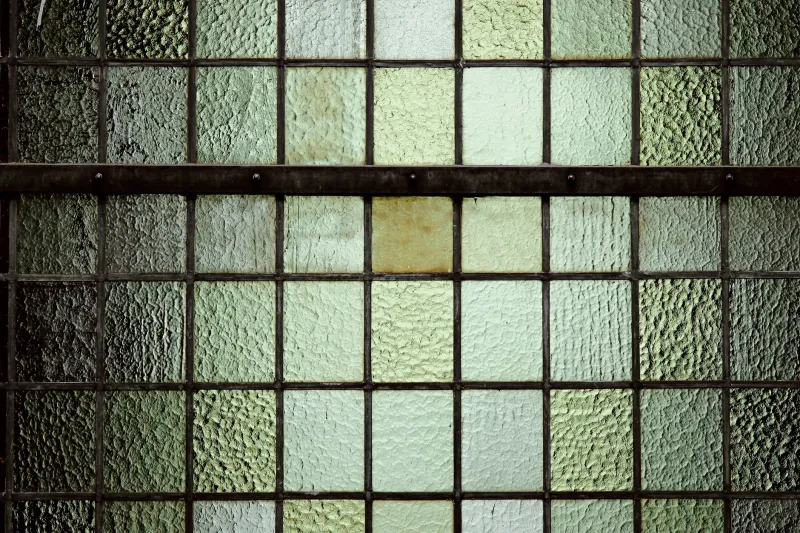
Good bathroom glass does not need to block the view entirely. It needs to break up the image. Texture is your friend here: hammered, seedy, reeded, glue-chip and frosted surfaces all scatter light and soften shapes. Lead lines add another layer of interruption, especially when the pattern is dense enough at eye level. A small repeating motif or a simple geometric grid can hide more than a large, open design with one bold flower in the middle.
Colour matters too. Pale amber, soft green and warm white opalescent glass give a gentle glow while keeping shapes indistinct. Deep reds and blues can be beautiful, but they also reduce daylight and may cast a theatrical tint over skin tones and mirrors. In a small bathroom, a little colour goes a long way. Think of it as seasoning rather than the main course.
If the window is overlooked only at the bottom, consider a panel with a denser pattern in the lower third and lighter glass above. That keeps the top of the window working as a daylight source while giving you cover where you need it. It is a more elegant solution than frosting every inch of glass and then wondering why the room feels gloomy in February.
Daylight, colour and the British sky
UK daylight is often soft, diffuse and a bit shy. That is good news for stained glass, because textured and opalescent glass come alive in gentle light rather than needing direct sun. It also means you should be cautious about designs that are too dark or too heavily painted. A bathroom is a working room, not just a viewing room. You need to see your face, find the toothpaste and avoid stepping out of the shower into a mystery.
Ask to see your chosen glass against a white background and a dark background. Opalescent glass can look creamy in one light and grey in another. If the window is small, keep the lead lines relatively fine so the panel does not feel like a grid of shadows. If the window is large, a stronger structure may be needed, but the pattern can still stay open and airy.
Steam is the real test
Condensation is the make-or-break issue in a bathroom. Moisture on the room side of the glass is normal if ventilation is poor. Moisture inside a sealed double-glazed unit is not normal; it means the seal has failed and the unit needs attention. With traditional leaded or copper-foiled panels, constant damp can attack cement, put stress on solder lines and encourage dirt to settle in crevices. That does not mean stained glass is unsuitable for bathrooms. It means the construction and the ventilation need to be thought through together.
Start with the room’s air. An extractor fan, a trickle vent or an opening window all help. Do not seal over existing vents in the frame, and do not pack insulation into a reveal in a way that blocks airflow. If you are fitting a new window, ask about background ventilation. If you are keeping an old sash, make sure it still opens and closes properly. A beautiful panel cannot compensate for a room that never loses its steam.
Lead, copper foil or encapsulated?
Lead came is the traditional choice and remains excellent for larger panels, geometric designs and period homes. It is strong, familiar and repairable. The cementing and finishing need to be done properly, and the panel should be looked after. In a steamy room, regular gentle cleaning and a check of the frame and putty will pay off.
Copper foil allows finer lines and more delicate detail. It is a good fit for smaller panels, intricate motifs and windows where you want the glass to do most of the talking. The solder lines and edges must be fully sealed and finished, because a bathroom is not the place for shortcuts. Copper foil panels can work well in a bathroom, but they are less forgiving if water sits against the edge for long periods.
Encapsulated panels are often the most practical answer for a warm, wet room. The stained-glass panel is sealed inside a double-glazed unit, so the lead or copper foil is protected from steam, cleaning products and condensation. You also gain thermal performance and some acoustic benefit. It costs more, and repairs are more involved, but for a modern bathroom or a well-used family bathroom it is a sensible investment. Make sure the panel maker and the glazing company talk to each other early, because the unit’s dimensions, thickness and safety glass requirements all need to line up.
Practical details before you commission
Measure the window reveal, not just the glass. Check how the window opens and whether a thicker panel will foul the frame or handles. In a sash window, the weight of the glass matters. In a heritage property or conservation area, check consent requirements before you change anything. And always ask about safety glass in critical locations; bathroom glazing often needs specialist advice, and a good maker will know when to bring in a glazier.
Finally, think about cleaning. Textured glass hides water marks better than smooth glass, but it still needs care. Avoid abrasive pads and harsh chemicals. A soft cloth, mild soapy water and a squeegee will do most of the work. If the window is hard to reach, choose a simpler pattern that does not trap dirt in deep recesses.
Bathroom stained glass works best when it is treated as a practical piece of joinery as well as a decorative one. Get the privacy, ventilation and construction right, and the glass can be as calm and useful as the room itself. At H&P Stained Glass, that is the kind of quiet double act we like: a window that keeps its secrets and still lets the morning in.