What Are You Paying For? A Clear-Eyed Guide to Stained-Glass Quotes
Stained glass has a way of turning a practical question into a romantic one. You start with a colour you love, a corner that needs light, or a door that deserves something better than plain glazing. Then the quote arrives, and suddenly you’re staring at a number that feels like it belongs to a different project altogether. It doesn’t have to be a mystery.
As of November 2026, a stained-glass commission is still a hand-made purchase. That means the price is rarely a simple matter of measuring a rectangle and multiplying by a rate. The good news is that once you know what sits behind the figure, you can compare estimates properly, ask better questions and avoid the nasty extras that turn a pleasant project into a spreadsheet headache.
Start with the size of the question
A small cabinet panel and a full staircase window are not the same animal, even if they use the same glass. Size affects material costs, but it also changes how much structural support is needed, how many pieces must be cut and joined, and how much time goes into drawing, fitting and finishing.
A domestic commission usually falls into one of a few broad groups: a decorative panel for a door, cupboard or bathroom; a window for a landing, kitchen or garden room; or a larger architectural window with multiple lights. Each step up brings more design work, more glass, more lead or foil, and usually more installation complexity.
Design is not the free bit
Design time is one of the first places where quotes differ. Some makers include a basic design within the commission price; others charge separately for site visits, sketches, colour studies and technical drawings. Neither approach is wrong, but you need to know which one you’re being offered.
For a straightforward domestic panel, design work might be a few hundred pounds. For a detailed figurative piece, a large window or a heritage project, it can be considerably more. Revisions also cost time. A maker who offers two rounds of changes and then charges for more is being clearer than one who promises unlimited revisions and quietly builds the risk into the final figure.
Ask whether the design fee is credited against the commission if you proceed. Ask who owns the drawings. Ask what happens if you change your mind after the glass is ordered. These are not awkward questions; they are the difference between a calm commission and a costly one.
Glass: the quiet budget-maker
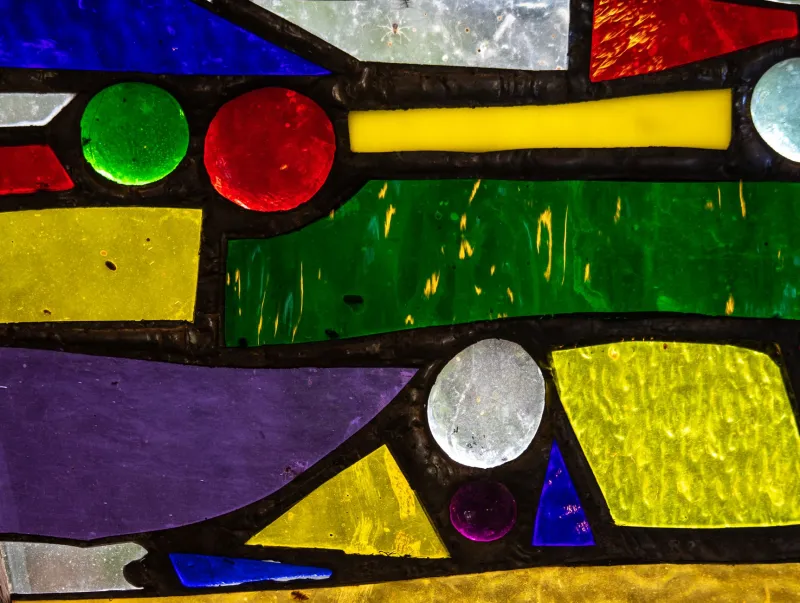
The glass itself can swing a quote more than many homeowners expect. Standard cathedral glass, textured glass and some machine-made coloured glass sit at the more affordable end. Mouth-blown antique glass, unusual streaky glass, hand-painted and fired work, and specialist conservation glass can push costs up sharply.
A simple geometric design in a modest range of colours will usually cost less than a painterly design with many subtle tones and custom-made pieces. That is not a reason to choose boring glass. It is a reason to talk about where the budget is best spent. A smaller panel with one beautiful piece of glass can feel more special than a larger panel made from a compromise palette.
Also ask about breakage allowance, spare glass and whether the maker will keep offcuts. Matching a colour later is far easier if someone has kept a piece of the same batch.
Lead, copper foil and the labour behind the lines
Lead came and copper foil are both traditional methods, but they suit different jobs. Lead is often the natural choice for architectural windows, door panels and larger pieces because it gives strength and a familiar rhythm. Copper foil is neat for smaller panels, detailed work and lampshades, but it is not automatically cheaper. Fine cutting, soldering and finishing can be labour-intensive.
A quote should tell you which method is proposed and why. If one estimate is much lower than another, check whether it assumes a simpler construction, fewer solder lines, a different glass range or less finishing. Cheaper is only cheaper if it is comparing like with like.
Installation, access and the bit everyone forgets
Installation is where hidden extras love to hide. Removing an old window, making good plaster, replacing rotten beading, fitting secondary glazing or encapsulation, and arranging access can all add to the bill. A first-floor window may need scaffolding or a tower. A heavy door panel may need two people and a careful hand. A listed building may need more documentation before anyone lifts a tool.
Ask whether installation is included, and if so, what exactly it covers. Does it include disposal of the old glass? Does it include making good? Does it include a return visit after the sealant has settled? If access is difficult, say so early. A maker who knows about the narrow alley, the conservation area or the awkward stair will quote more realistically than one who finds out on the day.
Heritage, listed buildings and conservation requirements
If your home is listed, in a conservation area, or the window is part of a church or historic building, the process can change the price before a single piece of glass is cut. Consent, conservation officer input, faculty jurisdiction, specialist methods and detailed recording all take time. They may also require materials and techniques that are more expensive than modern equivalents.
This is not box-ticking for its own sake. It is how historic fabric is protected. But it does mean you should ask whether the maker has experience of the relevant consent process, whether fees for reports or site meetings are included, and whether the quote assumes a straightforward domestic installation or a heritage one.
Rough ballparks for 2026
Every maker prices differently, so treat these as conversation starters rather than fixed tariffs. For a small decorative panel, you might see anything from a few hundred pounds to around a thousand, depending on design and glass. A bathroom or door panel often lands somewhere in the high hundreds to low thousands. A bespoke domestic window can run from a few thousand into five figures, and larger or more complex architectural work goes beyond that. Church conservation and restoration is a separate world, often starting in the thousands and rising steeply with scale, access and historic significance.
Add VAT where applicable, delivery, packing and a sensible contingency. A good quote should make those visible rather than leaving you to discover them later.
How to compare estimates without being blindsided
Don’t compare the bottom line alone. Compare the scope. Ask each maker for a breakdown covering design, glass, construction, installation, access, VAT, delivery and any exclusions. Ask what the lead time is, what the payment schedule looks like, and what warranty or aftercare is offered. Ask to see examples of similar work and, if possible, speak to a previous client.
Three detailed quotes will tell you more than five vague ones. The cheapest may be perfectly good, but it may also be assuming a simpler design, a easier installation or a glass range you haven’t actually chosen.
Stained glass is worth paying for because it does something ordinary glazing cannot: it changes how a room feels at different times of day and gives a building a piece of itself back. But the pleasure is much easier to enjoy when the quote is clear from the start. Ask for the detail, compare the whole job, and let the light be the only thing that surprises you.